

Key Takeaway: x̄ (pronounced “x-bar”) represents the sample mean in statistics. It’s calculated by adding all values in your sample and dividing by how many values you have, giving you the average of your sample group rather than an entire population. If you’ve spotted x̄ in your child’s math textbook or homework and wondered what […]

How to Teach the Vertex Formula at Home: A Simple Guide for Homeschool Parents
Teaching your child the vertex formula means showing them how to find the highest or lowest point of a parabola using the equation h = -b/(2a), then calculating k by substituting h back into the original quadratic function. This method takes about 45 minutes to teach effectively and requires only basic algebra skills, making it […]

How to Use Paul’s Online Math Notes for Homeschool Calculus 1: A Parent’s Guide
You can use Paul’s Online Math Notes for homeschool Calculus 1 by accessing the free, comprehensive course materials at, working through the complete lessons in sequence, and having your student practice with the included problem sets and worked solutions. This trusted resource, created by Paul Dawkins, a mathematics instructor at Lamar University, offers the same […]

How to Homeschool 3 Days a Week Without the Chaos: A Cleaning and Organization System That Actually Works
Yes, you can homeschool three days a week and still give your children an excellent education. This condensed schedule concentrates core academics into Monday through Wednesday (or any three consecutive days), freeing up the rest of the week for extracurriculars, co-ops, field trips, or simply breathing room for working parents and busy families. The approach […]
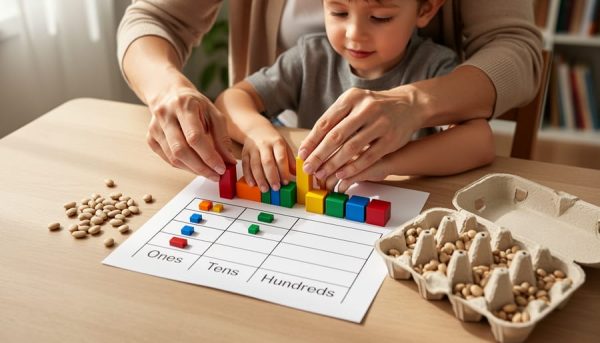
How to Teach Place Value: A Homeschool Parent’s Step-by-Step Method
Teaching place value at home takes three simple materials and about 15 minutes a day. You’ll use base-ten blocks (or homemade alternatives like dried beans and egg cartons), a place value chart you can draw on paper, and small manipulatives your child can physically move from column to column. The method works because children learn […]

What Is Applied Statistics and Probability for Engineers (and Why It Matters for Your Homeschooler)?
Applied statistics and probability for engineers is a college-level course that teaches engineering students how to collect, analyze, and interpret data to solve real-world problems and make informed decisions under uncertainty. It bridges the gap between mathematical theory and practical application, equipping future engineers with tools to design experiments, assess product reliability, control manufacturing quality, […]

Tesamorelin GHRH 1-44 Hexenoyl Modification: What Parents Should Know About This Peptide Research
The tesamorelin research peptide contains a specific chemical alteration that transforms how the body recognizes and processes this synthetic growth hormone-releasing hormone. Scientists added a hexenoyl group, a six-carbon fatty acid chain, to the first amino acid of the naturally occurring GHRH 1-44 peptide sequence. This single modification dramatically extends the peptide’s half-life in the […]

What Is Statistics For Dummies (and How Can It Help Your Homeschool)?
Statistics For Dummies is a comprehensive guidebook by Deborah J. Rumsey that breaks down statistical concepts into plain language, designed for readers who find traditional statistics textbooks overwhelming or confusing. For homeschool parents who feel intimidated by teaching math beyond basic arithmetic, this resource offers a lifeline: it explains everything from probability and distributions to […]

What Is an Outlier in Statistics (and How Do You Find One)?
In statistics, an outlier is a data point that differs significantly from other observations in your dataset. It’s the number that stands apart, sometimes dramatically, from the rest of your data. If you’re tracking your child’s quiz scores and they suddenly get a 45% after consistently scoring in the 80s and 90s, that low score […]

Teaching Textbooks Review: Is This Homeschool Math App Worth It in 2026?
Teaching Textbooks earns our recommendation as a solid, low-stress math curriculum for homeschool families who value independent learning and need a program that won’t require you to teach every single lesson. After using it with multiple kids across different grade levels, we found its gentle spiral approach and step-by-step audiovisual instruction genuinely deliver on the […]