

Yes, you can homeschool three days a week and still give your children an excellent education. This condensed schedule concentrates core academics into Monday through Wednesday (or any three consecutive days), freeing up the rest of the week for extracurriculars, co-ops, field trips, or simply breathing room for working parents and busy families. The approach […]
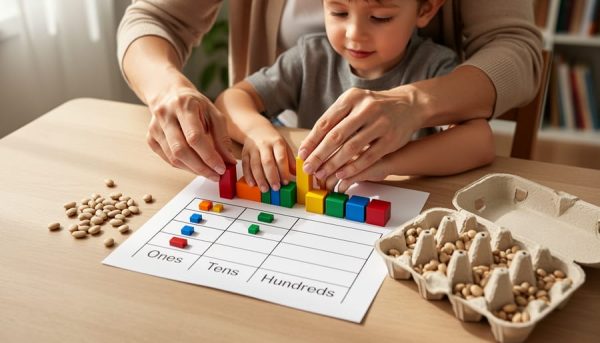
How to Teach Place Value: A Homeschool Parent’s Step-by-Step Method
Teaching place value at home takes three simple materials and about 15 minutes a day. You’ll use base-ten blocks (or homemade alternatives like dried beans and egg cartons), a place value chart you can draw on paper, and small manipulatives your child can physically move from column to column. The method works because children learn […]

How to Teach Trace in Linear Algebra: A Homeschool Parent’s Simple Guide
Teaching trace in linear algebra means showing your child how to add the diagonal entries of a square matrix to get a single number. That’s it. The concept itself takes about 15 minutes to explain, but true understanding comes from working through examples together and checking that your child can spot the diagonal, add correctly, […]

What Are Calculus Terms? (And How to Teach Them at Home)
Calculus terms are the specialized vocabulary used to describe rates of change, accumulation, and the behavior of functions in advanced mathematics. For homeschool parents guiding high school students, these words can feel like a foreign language, but they’re simply tools that express mathematical ideas with precision. If you’re supporting a teen through calculus this year, […]

Descriptive Statistics vs. Inferential Statistics: Key Differences and Which Your Homeschooler Needs
Most homeschooling parents supporting a student through upper-level math or science need descriptive statistics far more often than inferential statistics, but understanding both helps you choose the right courses and know when your child is genuinely ready for college-prep data analysis. Here’s the essential difference: descriptive statistics help you organize and summarize information you already […]

What Is Applied Statistics and Probability for Engineers (and Why It Matters for Your Homeschooler)?
Applied statistics and probability for engineers is a college-level course that teaches engineering students how to collect, analyze, and interpret data to solve real-world problems and make informed decisions under uncertainty. It bridges the gap between mathematical theory and practical application, equipping future engineers with tools to design experiments, assess product reliability, control manufacturing quality, […]
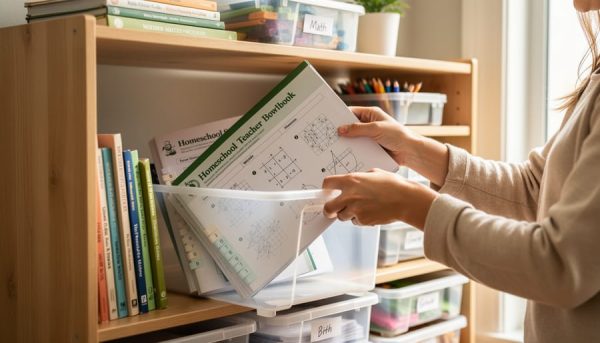
How to Organize Homeschool Curriculum So You Can Actually Find What You Need
You can organize your homeschool curriculum in about two hours by grouping materials into daily use, weekly rotation, and reference categories, then storing each where you’ll actually use it. This system cuts lesson-prep time by half because you’re no longer hunting for that spelling workbook or last week’s science experiment supplies when three kids are […]
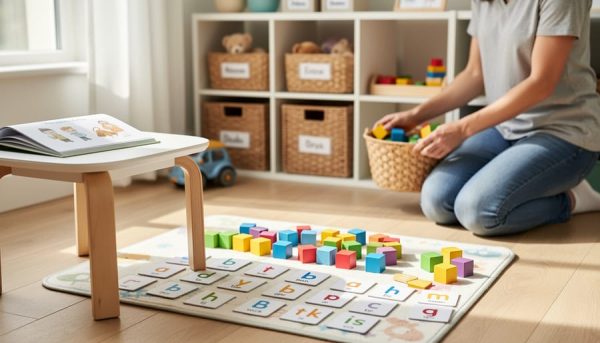
How to Build a Kindergarten Homeschool Schedule That Keeps Your Home Clean and Organized
Creating an effective kindergarten homeschool schedule means building a flexible 2-3 hour daily structure that balances short learning bursts with plenty of hands-on activities and movement breaks. For five and six-year-olds, attention spans max out at about 15-20 minutes per subject, so your schedule needs to flow between activities quickly while still covering essential skills […]

What Is Statistics For Dummies (and How Can It Help Your Homeschool)?
Statistics For Dummies is a comprehensive guidebook by Deborah J. Rumsey that breaks down statistical concepts into plain language, designed for readers who find traditional statistics textbooks overwhelming or confusing. For homeschool parents who feel intimidated by teaching math beyond basic arithmetic, this resource offers a lifeline: it explains everything from probability and distributions to […]

What Is an Outlier in Statistics (and How Do You Find One)?
In statistics, an outlier is a data point that differs significantly from other observations in your dataset. It’s the number that stands apart, sometimes dramatically, from the rest of your data. If you’re tracking your child’s quiz scores and they suddenly get a 45% after consistently scoring in the 80s and 90s, that low score […]