
Paul’s Online Notes is a free website where you can open a course, download the notes, and work through Algebra or Calculus I, II, and III at your own pace. That’s the whole method. You pick the course that matches where your student is, grab the notes, and use them alongside practice problems until the ideas click.
Here’s why it works for a homeschool setting. The Calculus I notes are the same ones Paul Dawkins uses to teach his Calculus I course at Lamar University, so your student is learning from material built for a real college classroom. No login hoops, no mystery. The notes are downloadable, which means you can print them, highlight them, and keep them in a binder.
I’ll be honest, when my own kids first hit higher math, I felt that familiar flutter of panic. I hadn’t touched calculus since my own school days, and I worried I’d be the bottleneck. What helped me most was finding a clear, free resource I could read right alongside them, so we were learning together instead of me pretending to know it all.
You don’t need a math degree to make this work. You need a quiet spot, a notebook, a pencil, and about thirty minutes a day to start. This guide walks you through exactly what to gather, how to move through the notes step by step, and how to check that your student is truly getting it.
What Paul’s Online Notes Is and Why Homeschool Families Are Talking About It
If you’ve been searching for “pauls notes calculus,” here’s what you’re actually looking for: a site called Paul’s Online Notes. It’s a collection of math notes you can read online or download, and it’s free. For homeschooling families, that combination is hard to beat.
Here’s a quick look at the key details:
- The site is called Paul’s Online Notes.
- The notes are free and downloadable.
- It includes notes for Algebra, Calculus I, Calculus II, and Calculus III.
- The Calculus I notes are used by Paul Dawkins to teach his Calculus I course at Lamar University.
That last point is the one that gave me the most confidence. When you open the Calculus I notes page you’re looking at material that a real instructor uses to teach a real college course. These notes weren’t written as an afterthought for the internet. They were built for a classroom, and that shows in how they’re organized.
So why are so many homeschool families talking about it? Because it fits the way we teach. You can download the notes and keep them in a binder, or pull them up on a tablet at the kitchen table. Your student can work through a topic on Monday and come back to it on Thursday, with nobody waiting on a class schedule. And since the notes cost nothing, you can try them out without worrying about whether it’s the “right” purchase.
For a parent who isn’t sure how to approach calculus, that kind of steady, self-paced guide takes a lot of pressure off.
What You’ll Need Before You Start: Tools and Materials
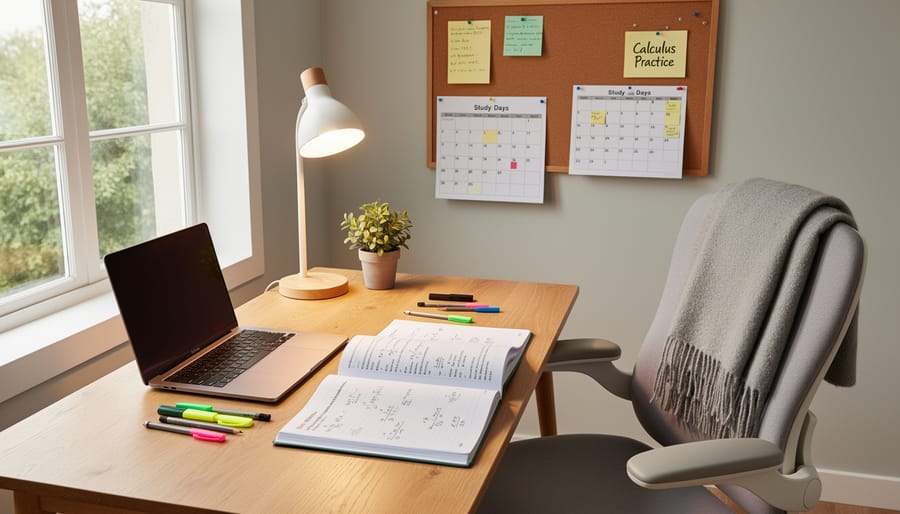
Good news: you don’t need a fancy setup to get started. Since the notes are free and downloadable, most of what you need is probably already sitting in your home. When I first set up our math corner, I was convinced I’d have to buy a pile of supplies. I didn’t.
Here’s a simple checklist to gather before you begin:
- A computer or tablet with internet access, so you can visit the notes and download what you need.
- A way to print the notes, or a spot on your device to save them.
- A notebook for working problems by hand, since calculus really sticks when pencil meets paper.
- A pencil and a good eraser (you’ll use the eraser, and that’s perfectly normal).
- A calculator, if your family decides it’s helpful.
- A three-ring binder with tabbed dividers for printed notes.
That binder is worth it. Sort your printed pages by topic as you go, and you’ll never be hunting for last week’s notes in a pile of loose paper. If you like to organize your curriculum in a way that makes everything easy to find, a binder for each course (Algebra, Calculus I, and so on) keeps things tidy.
Finally, pick a quiet, consistent study spot. It doesn’t have to be a dedicated room. A kitchen table at the same time each day works beautifully. A predictable place helps your student settle in and get focused faster, and that makes the whole routine feel calmer for both of you.
Before You Dive In: Prerequisites and Smart Stopping Points
Calculus is built on algebra, so before you open the Calculus I notes, take an honest look at how steady your student feels with the basics. Think of it as checking the foundation before you put up the walls. Paul’s Online Notes includes Algebra as well as Calculus I, II, and III, which means a refresher is right there on the same free site if you need one.
Here are a few things to watch for as you go:
– Your student gets frustrated over and over on basic algebra steps, like moving terms around or simplifying fractions.
– Practice problems start getting skipped because they feel like too much.
– The pace speeds up, with new topics piling on before the last one has really settled.
If you notice any of these, that’s your cue to ease off the gas. It isn’t a sign that anything’s wrong. Pausing is a strength, and it usually means your student is being honest about what they need.
I learned this one the slow way. Early on, I pushed ahead with a tricky math unit because the schedule said it was time. My daughter started doodling in the margins, and I could tell she was only nodding along. So we stopped, went back two lessons, and spent a week on the shaky parts. When we returned to the new material, it clicked in about half the time. That week felt like a detour, but it was really a shortcut.
Step-by-Step: How to Get Started With Paul’s Online Notes
Choosing the Right Course for Your Student
Not sure where to begin? Match the starting point to where your student is right now. Paul’s Online Notes includes Algebra, Calculus I, Calculus II, and Calculus III, so there’s a natural spot for almost everyone.
If your teen needs a refresher on equations, functions, or factoring, start with Algebra. If they’re meeting calculus for the first time, Calculus I is the place to begin. Students who’ve finished Calculus I can move on to Calculus II, and then Calculus III. It also helps to get comfortable with basic calculus terms before diving in, so the notes feel familiar rather than overwhelming.
Once you’ve picked a course, here’s how to get going:
- Open Paul’s Online Notes in your web browser.
- Choose the course that fits your student: Algebra, Calculus I, II, or III.
- Pick a single section or topic to study first.
- Download the notes for that topic.
- Read through the notes together, then work the examples on paper.
There’s no wrong place to start. You can always adjust.
Building a Weekly Rhythm Around the Notes
Short and steady wins with calculus. Aim for one topic at a time and a session of thirty to forty-five minutes, four or five days a week. That’s plenty when the material is new.
At first, sit down and read the notes together. This works a lot like direct instruction where you walk through the idea and the first example side by side before your student tries anything alone. Once they’ve got the hang of it, step back and let them take the lead while you listen.
In our house, I settled into a simple read, try, review pattern. We’d read a section on Monday, and my daughter would work a few problems on paper on her own. On Friday we’d go back over anything that tripped her up, and she’d redo one missed problem. I wasn’t grading her. I was just looking for the moment she could explain a step in her own words.
Keep the week predictable and the pace gentle. If a topic needs a second day, give it one. Nothing in the notes is going anywhere, and your student can return to a section whenever they need to.
Tips for Teaching Calculus When You’re Not a Math Whiz

You don’t have to be a math whiz to teach calculus at home. Honestly, the best thing you can do is stop pretending you have all the answers and start learning right alongside your student.
When my daughter hit her first calculus topic, I stared at the page and felt that familiar knot in my stomach. So I sat down next to her, opened the notes, and said, “Let’s figure this out together.” We stumbled through limits side by side, and she taught me as much as I taught her. That’s when I realized the notes could be the steady guide, so I didn’t have to carry the whole load myself.
Here are a few simple ways to keep things supportive and low-pressure:
- Ask your student to explain each concept back to you in their own words.
- Keep a running list of questions to look up later, instead of freezing mid-lesson.
- Read a section together first, then let them try an example on their own.
- Celebrate small wins, like solving one tricky problem or catching their own mistake.
- Let it be okay to say, “I don’t know yet, but we’ll find out.”
Teaching by explanation is powerful because it shows you what’s really clicking. If your teen can walk you through a step, they understand it. If they stumble, you’ve found exactly where to slow down, and that’s useful information, not a failure. Lean on the free, downloadable notes whenever you need a clear explanation, and remember that your encouragement matters far more than your math skills.
How to Tell the Notes Are Working: Checking Progress and Next Steps

You’ll know the notes are working when your student can show it, not just say it. A few simple checks make this easy, even if you’ve never taken calculus yourself.
Start with the explain-it test. After a lesson from Paul’s Online Notes ask your student to teach the idea back to you in their own words. If they can do that without reading from the page, it’s sticking. Next, try the no-peeking test: have them work an example from a blank sheet of paper while the notes stay closed. Finally, watch for self-correction. A student who catches their own slip, like a dropped negative sign, is building real understanding.
Keep the rhythm gentle. A weekly review session works well, where your student redoes one problem they missed earlier in the week. Getting it right the second time is a quiet little victory worth celebrating.
When those checks feel comfortable, it’s time for the next step. Students who finish Calculus I can move on to Calculus II and then Calculus III. Later on, many families find that calculus naturally opens the door to topics like differential equations. And if the same kinds of mistakes keep appearing, don’t worry. Circle back to the Algebra notes to patch those gaps first. Going back isn’t falling behind, it’s building a stronger foundation.
Common Questions About Paul’s Online Notes for Homeschoolers
Parents often ask the same handful of questions when they first hear about this resource, so here are honest answers based on what we know. Take a look, then browse the notes yourself to see whether the style suits your student.
Is Paul’s Online Notes free?
Yes, the notes are free and downloadable. I’d skip any guesses about extras beyond the notes themselves, so check the site directly for the full picture.
Which courses does it include?
You’ll find notes for Algebra, Calculus I, Calculus II, and Calculus III. That gives you a path from a math refresher all the way through multivariable calculus.
Who is Paul Dawkins?
Paul Dawkins uses the Calculus I notes to teach his own Calculus I course at Lamar University. That means the material was built for a real classroom, not just for browsing.
Can the notes be downloaded?
They can, which is handy if you’d like to print them and keep them in a binder. Having a paper copy makes it easy to highlight and jot questions in the margins.
Is it enough on its own for a full calculus course?
It can be a strong anchor, but whether it’s enough depends on your student and your goals. Read through a section or two together first, and if your teen likes the explanations, you can add whatever extra practice or support feels right.
None of these answers replace your own judgment. You know your child best, and a quick look through a topic or two will tell you far more than any review could.
So here’s where we land: Paul’s Online Notes gives you a free, downloadable path through Algebra and Calculus I, II, and III. You don’t need a pricey curriculum or a math degree to get started. You just need a quiet spot, a notebook, and a willingness to take that first small step.
If calculus still feels a little big, that’s okay. Start with one topic, one short session, and let your student’s confidence grow from there. Pausing to revisit algebra isn’t a detour, it’s part of the road.
I think back to that first math subject I wasn’t sure I could teach, and how much I worried for nothing. What carried us through wasn’t my expertise. It was showing up, learning alongside my kids, and trusting that we’d figure it out together. You can do the same. Trust yourself, and trust your kids.
When you’re ready for more encouragement, explore the other homeschooling resources here at Sunny Patch Homeschooling. We’re glad you’re here.