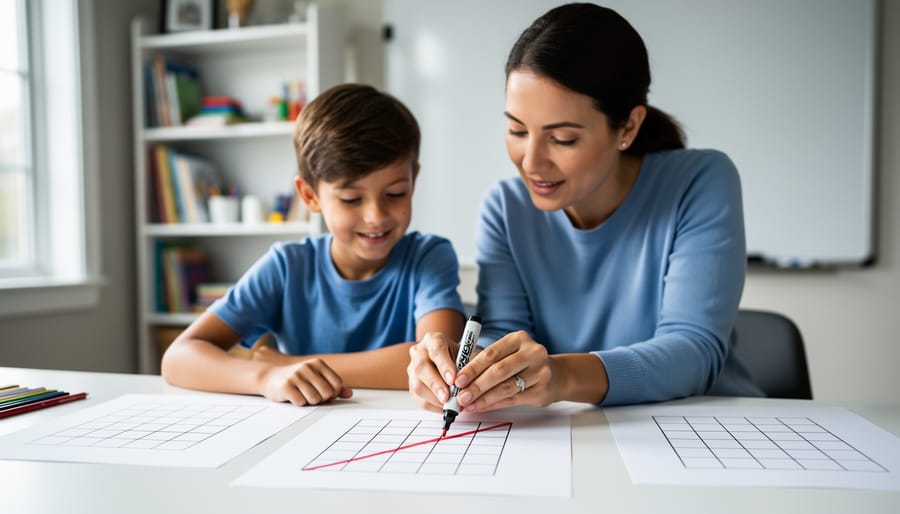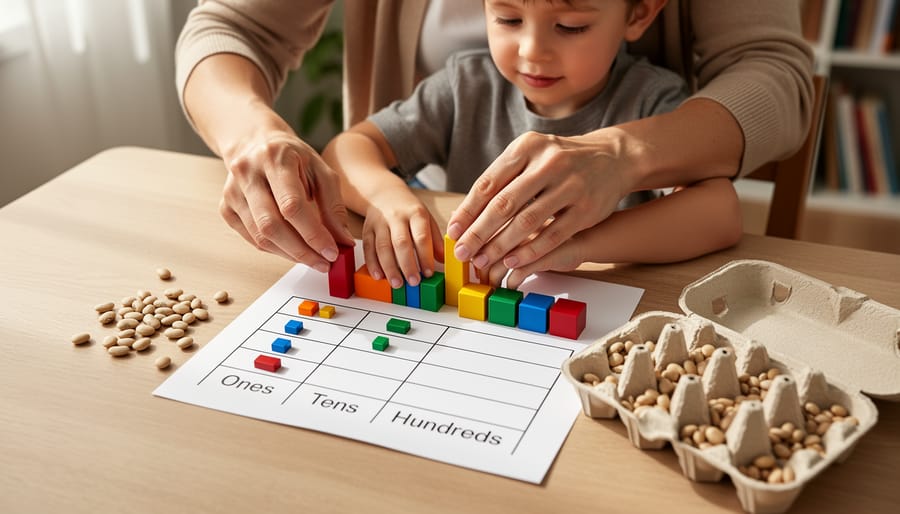
Teaching place value at home takes three simple materials and about 15 minutes a day. You’ll use base-ten blocks (or homemade alternatives like dried beans and egg cartons), a place value chart you can draw on paper, and small manipulatives your child can physically move from column to column. The method works because children learn abstract number concepts best when they can see and touch the quantities they represent.
I learned this the hard way with my oldest. We’d been working through a traditional math workbook, and she could recite that 34 had “three in the tens place and four in the ones place,” but when I asked her to show me with blocks, she had no idea why three meant thirty. She was parroting without understanding. That’s when I realized place value isn’t something you explain once. It’s something children need to build, physically and repeatedly, until the connection between position and value becomes second nature.
Most parents who get started homeschooling feel anxious about teaching math. You might worry you’ll confuse your child or skip something critical. But place value is actually one of the most satisfying concepts to teach at home because progress is visible. When your seven-year-old can bundle ten loose beans into a group and confidently move it to the tens column, you’ll both know she gets it.
The step-by-step method I’m sharing builds understanding in the exact sequence children’s brains are wired to learn: concrete objects first, then pictures, then abstract numbers. No teaching degree required, just patience and the willingness to let your child manipulate materials until the light clicks on.
What You’ll Need: Materials and Tools for Teaching Place Value
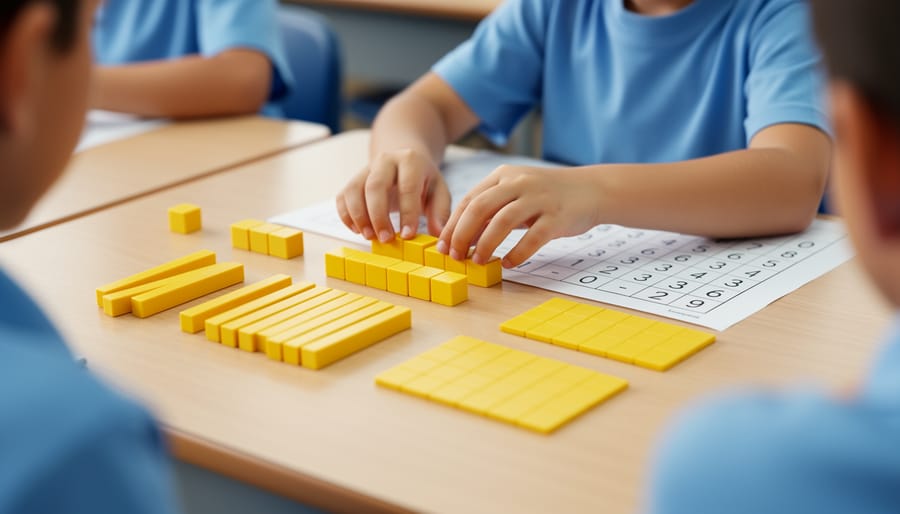
You don’t need to raid a teacher supply store or spend hundreds on fancy math kits to teach place value effectively. Most of what works best for helping children grasp this foundational concept is already in your home or available for a few dollars at the dollar store.
The most valuable resource is base-ten blocks, wooden or plastic sets that show individual units, rods of ten, and flats of one hundred. These manipulatives make the grouping system visible and tangible. If purchasing a set feels like too much, you can achieve the same effect with household items: dried beans or buttons for ones, bundles of ten straws held with rubber bands for tens, and larger containers representing hundreds. My own kids learned just as well with painted popsicle sticks bundled into groups as they did with commercial blocks.
A simple place value chart transforms random groupings into an organized system. You can print free templates online or draw three columns on paper labeled “hundreds,” “tens,” and “ones.” When you set up a homeschool room laminating a few charts makes them reusable with dry-erase markers.
- Base-ten blocks or household substitutes (beans, buttons, bundled straws) for hands-on grouping
- Place value charts, printed or hand-drawn, to organize materials by position
- Small containers or muffin tins to physically separate groups during counting
- Printable worksheets for bridging manipulatives to written numerals
- Index cards or sticky notes for building and rearranging numbers
- Optional: digital apps or videos that animate regrouping for visual learners
Worksheets that show empty place value boxes next to problems help children connect the physical work to written math. Free printables are everywhere online, or you can create your own tailored to exactly where your child is working.
Digital resources can supplement but shouldn’t replace the concrete work. A few well-chosen apps or YouTube videos showing animated regrouping can help visual learners, but the physical manipulation is where real understanding happens. Keep screens optional and secondary to hands-on practice.
Before You Begin: What to Watch For
Place value isn’t a race, and one of the biggest gifts of homeschooling is permission to honor your child’s actual readiness rather than a curriculum chart’s timeline. Before you gather your manipulatives and dive in, take a moment to assess where your child truly is, not where you think they should be.
Most children aren’t developmentally ready for place value concepts until around age five or six, when they’ve mastered stable counting and understand that numbers represent quantities. If your child is still working on counting to twenty or doesn’t reliably grasp one-to-one correspondence, place value will feel like abstract nonsense. That’s not a deficit. It’s just developmental reality, and pushing too early creates frustration without building understanding.
Watch for signs your child isn’t ready yet: blank stares when you ask them to show you “ten,” inability to compare which group has more, or tears during what should be playful exploration. These aren’t failures. They’re signals to spend more time on foundational counting games and come back to place value in a few months.
I learned this the hard way with my oldest. Eager to keep pace with what her traditionally-schooled peers were doing, I pushed into place value charts before she really understood grouping. She dutifully memorized where to write digits, but when I asked her to show me what the numbers meant with blocks, she couldn’t do it. We backed up, spent six weeks just making piles of ten with beans and buttons, and then everything clicked. That “lost” time wasn’t lost at all, it was the foundation we’d tried to skip.
The Step-by-Step Process: Teaching Place Value from Concrete to Abstract
Step 1: Start with Concrete Grouping
Start by handing your child a pile of small objects, dried beans, buttons, Lego bricks, whatever’s handy, and ask them to count out exactly ten. Then have them count out ten more, and ten more again. The physical act of grouping matters because children need to feel that ten isn’t just a word, it’s a quantity they can hold in their hands. This tangible experience forms the foundation for everything that comes later in homeschool planning for math.
Once they’ve made several groups of ten, have them count the total by tens: ten, twenty, thirty. Then add a few loose ones and count those separately. The goal isn’t speed or perfection, it’s building the visceral understanding that numbers bigger than ten are really just groups of tens plus some extras. I’ve watched children’s faces light up when they realize they can count seventy-three objects without counting every single one.
Try this daily for a week before moving on. Make it playful: count out ten crackers for a snack, bundle ten pencils together, sort coins into piles of ten. The more they group, the more automatic the pattern becomes.
Step 2: Introduce Place Value Language
Once your child is comfortable grouping objects into tens, it’s time to give those groups official names. This is where you introduce the words “ones,” “tens,” and “hundreds”, but you’re still working with the same manipulatives, not abandoning them for abstract numbers yet.
Start by narrating what you’re already doing together. When your child bundles ten beans, say, “You just made one ten! And we have three ones left over.” Point to the bundle as you say “ten” and the loose beans as you say “ones.” Repeat this language consistently across different activities. The goal isn’t memorization; it’s building an automatic connection between the physical reality your child can see and touch, and the mathematical vocabulary that describes it.
I noticed with my own kids that natural conversation worked better than drilling. We’d be sorting buttons into piles of ten, and I’d casually ask, “How many tens do we have now?” rather than turning it into a quiz. When they responded, even if they had to count the piles, I’d affirm: “Right, four tens. That’s forty buttons!” This weaves place value language into genuine interaction, making the terms feel like useful tools rather than arbitrary labels to memorize.
Step 3: Use Visual Place Value Charts
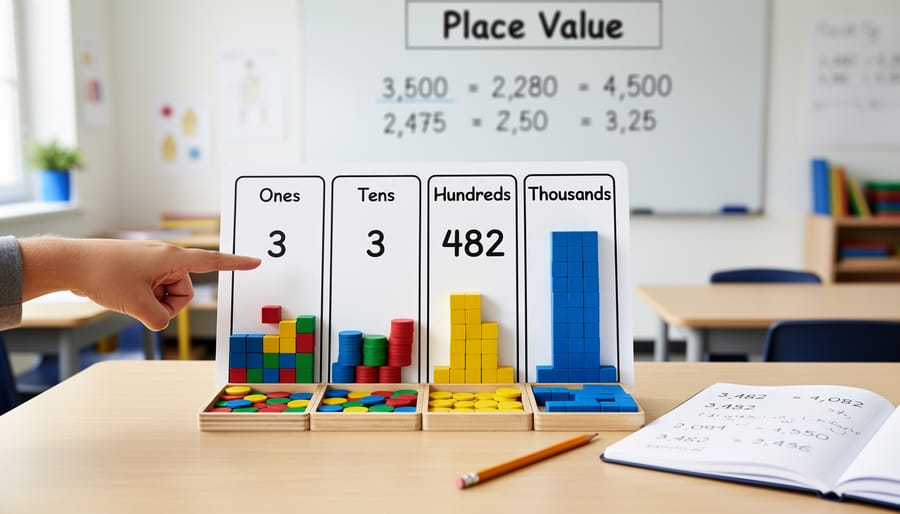
Once your child can confidently group objects into tens, it’s time to make the positional system visible and systematic with a place value chart. You can draw simple columns on paper, label them “ones,” “tens,” and “hundreds”, or print a template. The chart gives each place its own space, so when your child puts two groups of ten beans in the tens column and three single beans in the ones column, they see 23 taking shape right in front of them.
This step cements the idea that position matters. A counter in the tens column represents ten; the same counter in the ones column represents one. Have your child build numbers on the chart with manipulatives, then say the number aloud. Ask them to make 35, then 53, and watch them realize the digits swap places because the groupings move. It’s the same materials as Step 1, just organized spatially, and that organization is everything. Keep the chart alongside your other teaching tools as you organize your curriculum so it’s always within reach for quick practice.
Step 4: Connect to Written Numbers
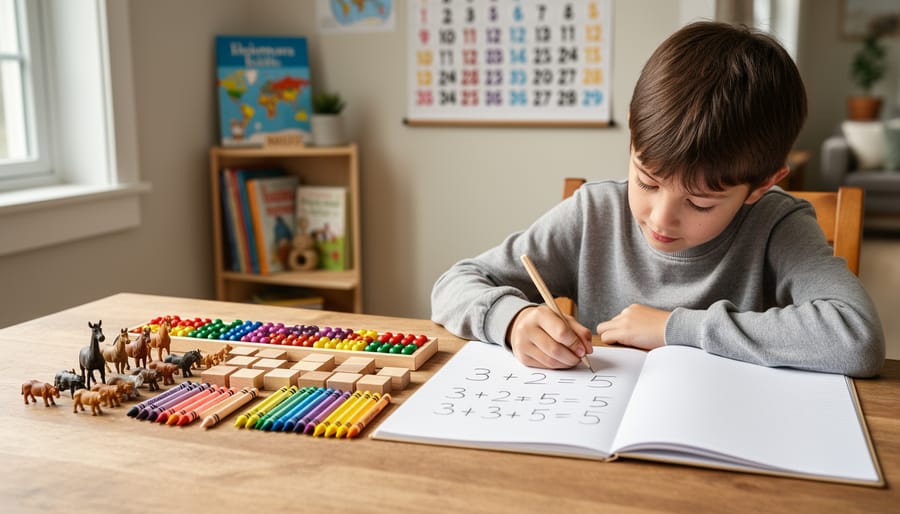
This is where place value truly clicks for most children, when they see that the number “23” on paper means exactly the same thing as the two bundles of ten straws and three single straws they’ve been arranging on their chart.
Start by building a number with manipulatives, then write the matching numeral beside it. Say it out loud together: “Two tens and three ones makes twenty-three.” Point to each column as you write each digit. Your child needs to see that the “2” goes in the tens place because it represents those two groups of ten, not two individual items.
Then reverse the process. Write a number first and ask your child to build it with their materials. This back-and-forth practice, from concrete to written, then written to concrete, cements the connection. They’re translating between two languages: the physical language of grouped objects and the symbolic language of numerals.
Expect some confusion initially. Children often want to write “23” as “203” because they see two tens and three ones as separate entities. That’s normal and shows they’re thinking it through. Keep practicing with smaller two-digit numbers before moving to three digits, and celebrate when they start writing numbers correctly without counting out the manipulatives first.
Step 5: Practice Expanded Form
Once your child comfortably connects manipulatives to written numbers, expanded form becomes the next powerful tool. This is where you explicitly show that 347 isn’t just three random digits, it’s 300 + 40 + 7, three distinct quantities combined.
Start by building the number with your blocks or objects on the place value chart. Point to the hundreds column: “We have 3 hundreds here. That’s 300.” Move to the tens: “We have 4 tens. That’s 40.” Then the ones: “And 7 ones.” Write it out together: 347 = 300 + 40 + 7. Say it aloud several times.
Practice this process with different numbers daily. Have your child build a number, then write the expanded form. Or give them the expanded form (200 + 80 + 5) and ask them to build it, then write the standard numeral (285). The back-and-forth repetition cements that each position holds a completely different value.
What clicks here is understanding that the 3 in 347 doesn’t mean “three”, it means “three hundred.” That realization, that position determines value, is the heart of place value. When your child can break apart and rebuild numbers this way without hesitation, you’re watching genuine mathematical thinking take root.
Step 6: Work Toward Mental Flexibility
Once your child can confidently decompose numbers using the standard grouping, 3 hundreds, 4 tens, and 7 ones, it’s time to push their thinking further. Real number sense means seeing the same number through different lenses. Ask: “How many tens are in 347?” The answer isn’t just four. It’s actually 34 tens (with 7 ones left over). This flexibility, understanding that 347 can be 3 hundreds, 4 tens, 7 ones, or 34 tens and 7 ones, or even 347 ones, prepares them for everything that comes next in math.
I like to play a quick game: “Give me three different ways to build this number with your blocks.” Let them experiment. The goal isn’t speed or memorization. It’s genuine comfort with regrouping and seeing relationships between place values. When your child can shift effortlessly between these representations, they’re ready for addition with regrouping, subtraction across zeros, and eventually multiplication strategies that rely on breaking numbers apart and putting them back together.
How to Know It’s Working: Checking Understanding and Next Steps
The best indicator of true place value understanding isn’t whether your child can fill in a worksheet, it’s whether they can explain their thinking out loud and solve problems in different ways. Ask questions that require genuine understanding: “Can you show me 45 using blocks in two different ways?” or “What’s the difference between the 3 in 35 and the 3 in 53?” A child who really gets it can switch between representations without panic, moving from blocks to numbers to words without losing track of what each digit means.
Watch for flexibility in their answers. Real mastery looks like a child who can break 128 into 100 + 20 + 8, but also recognizes it as 12 tens and 8 ones, or even 128 ones if needed. Surface memorization shows up as rigid responses, they can only give you one right answer, usually the one you just taught. If your child freezes when you present a number in an unfamiliar format or can’t explain why regrouping 10 ones for 1 ten makes sense, they need more time with manipulatives before moving on.
How long does it take to teach place value properly?
Most children need several weeks of regular practice to move from concrete grouping to flexible mental understanding. Rushing through in a few days creates shaky foundations that crumble later.
What if my child still doesn’t get it after weeks of practice?
Step back to simpler counting and grouping activities without the place value vocabulary. Some children need more time building number sense before the positional system clicks.
When should we move to the next math concept?
Move forward when your child can confidently explain their thinking with different numbers and representations. The next natural steps are addition and subtraction with regrouping, which build directly on place value understanding.
Once your child demonstrates solid place value understanding, you’re ready for addition and subtraction with regrouping, the skills that make place value knowledge practical. After that comes multiplication (which relies heavily on understanding how place value affects products) and eventually decimals (just place value extended in the other direction). Each concept builds on this foundation, which is why taking time now saves frustration later.
Keep the learning playful through review games that reinforce place value concepts without feeling like drill work. If you want to deepen your own understanding of math teaching, workshops and learning events can provide valuable support. Some Canadian conferences scheduled for fall 2026 include sessions in Vancouver on October 25-26, with additional learning opportunities in July 2026. These professional development sessions help homeschool parents build confidence in teaching concepts they may not have fully understood themselves as students.
Trust your observations of your child more than any timeline or curriculum scope-and-sequence chart. You’ll know they’re ready to move forward when math conversations flow naturally and numbers feel like flexible tools rather than mysterious symbols.
Here’s the truth I’ve learned after two decades of homeschooling: you don’t need a teaching degree to help your child understand place value. You need patience, a handful of manipulatives, and the willingness to slow down when they need more time. Traditional classrooms move at the pace of the curriculum. You get to move at the pace of your child, and that’s your superpower.
I remember doubting myself constantly in those early years. Was I doing enough? Was I doing it right? But here’s what I discovered: the very things that made me nervous, having to explain concepts in my own words, needing to understand them myself first, watching closely to see what clicked, those turned out to be strengths, not weaknesses. Every time I sat down with base-ten blocks and really observed how my children grouped and counted, I learned something about how they thought.
The work you’re doing right now, building this foundation brick by brick, sets your child up for years of confident math learning. Place value isn’t just about understanding numbers in the hundreds. It’s the skeleton that supports addition with regrouping, multiplication, decimals, and eventually algebra. You’re not just teaching a single concept. You’re giving your child a framework for thinking about quantity and position that they’ll use for the rest of their lives.
You’re more capable than you think. Trust your instincts, follow your child’s cues, and remember that understanding always matters more than speed. You’ve got this.