
Newton and Leibniz share the title, because calculus wasn’t invented by one person. In the late 1600s, Isaac Newton in England and Gottfried Wilhelm Leibniz in Germany each developed it independently, and historians today credit them as joint founders. Newton called his version “fluxions” and built it to study motion and change. Leibniz took his own path to the same destination. Some sources still hand Newton the solo crown, since he’s also called the father of modern physics, but the fuller story gives both men their place.
If you’re a parent staring at a pre-algebra textbook and wondering where all of this came from, you’re in good company. It’s a fun question to bring to the kitchen table, and the answer makes a better lesson than any single name would.
The Newton and Leibniz story shows kids that big ideas rarely belong to one genius working alone. Two curious minds, working separately, arrived at the same powerful tool. That’s a message worth sharing with a child who thinks math is just a pile of rules handed down from nowhere.
My friend Therese Tyler loves to say that history is the secret ingredient that makes math feel human, and she’s seen it turn a groaning math hour into a lively conversation more than once. Below, we’ll compare the two men side by side, then turn their story into simple ways to teach it at home.
Newton and Leibniz at a Glance
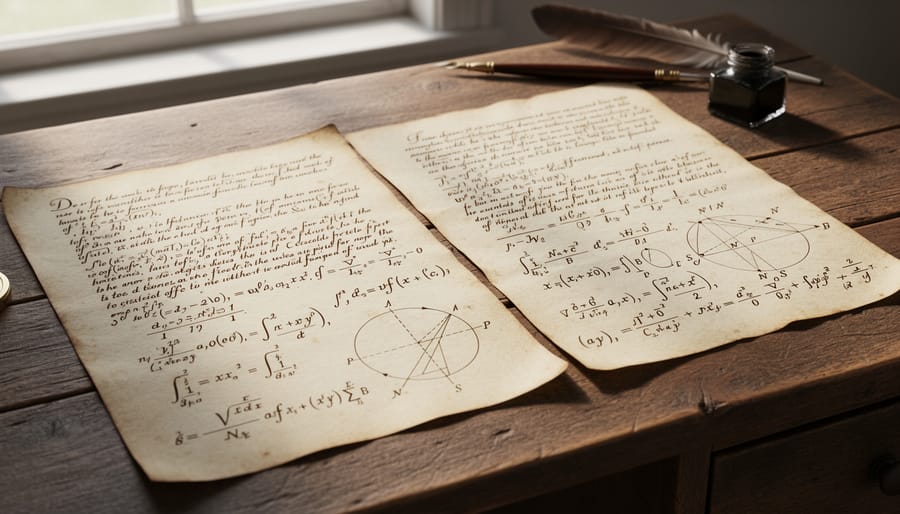
Meet the Two Mathematicians: What Each Man Brought to Calculus
Isaac Newton and ‘Fluxions’
Newton developed his version of calculus under the name “fluxions,” and he built it as a tool for studying motion and change. That’s a mouthful, but the idea is friendlier than the word.
Picture a car pulling out of your driveway. At first it creeps along, then it speeds up, then it settles at a steady cruising pace. Newton wanted a way to describe exactly how fast something is changing at any single moment, not just over the whole trip. Your speedometer does this for a car. A “fluxion” was his way of capturing that moment-by-moment rate of change.
You can try this at home with a ball rolling down a ramp or a hallway. Ask your child, “Is it going faster now than a second ago?” That question is the heart of what Newton was after. No equations needed, just curiosity and a ball.
Gottfried Wilhelm Leibniz and Infinitesimal Calculus
Gottfried Wilhelm Leibniz is the other half of the “father of calculus” story. Working independently of Newton, he is considered a founder of infinitesimal calculus, and today he gets shared credit alongside Newton.
That word “infinitesimal” sounds fancy, but the core idea is friendly: studying change by looking at incredibly tiny pieces of something. Think of slicing a loaf of bread so thin you could barely see each slice, then adding them all back up.
What I love for our homeschool families is the independence of it all. Leibniz wasn’t copying anyone. He tackled the same big questions on his own and reached his own answers, which is a lovely thing to point out to a curious kid.
Priority, Independence, and Credit: How the Two Stack Up

Why ‘Who Invented It First?’ Is the Wrong Question and a Great Teaching Moment
“Who invented it first?” is the question most kids ask, and it’s a fair one. But here’s the twist: the better story is that two thinkers, Newton in England and Leibniz, arrived at the same big idea independently in the late 17th century. Neither one was copying a lesson plan. They were each chasing a real problem, like how to describe motion and change.
That’s your teaching moment. Ideas don’t pop out of one genius’s head in isolation. They grow when curious people keep asking “what if?” at the same time. It’s a reminder that your child’s own questions, the wandering ones that pull you off the schedule, are exactly how real discoveries begin. Following curiosity isn’t a detour from learning. In a homeschool, it is the learning.
Try asking your child, “What would you want to figure out if nobody had solved it yet?”
Bringing the Newton vs. Leibniz Debate Into Your Homeschool Math Plan
Younger Learners: Keep It a Story
Kids this age don’t need a single equation to get the big idea. Start with a story: “Two people on opposite sides of the sea were working on the same puzzle, and neither knew the other was close to solving it.” That’s the Newton and Leibniz tale in a nutshell, and little ones love a good mystery.
Then let them make it their own. Have your child draw the two thinkers at their desks, or act it out with stuffed animals. Read-alouds about famous scientists work well too, and a short direct instruction moment, just a few minutes of you explaining the idea clearly, keeps it simple.
Keep it playful. Ask, “Could two kids invent the same game without meeting?” That’s calculus history, no math required.
Older Learners: Connect the History to the Math
Once your teen has the basics of rates of change, such as how fast a car’s speed is changing, bring the history in. Newton and Leibniz both reached these ideas independently, so ask your student what it means when two people solve the same problem at once. Who gets the credit, and why does sharing it matter in science?
Then connect it to the math itself. A short list of calculus terms, like “derivative” and “rate of change,” helps the story stick, and our guide to calculus terms walks through teaching them at home. Reading a few Calculus 1 notes together turns the debate into real practice.
Planning the bigger picture? See our post on planning high-school math at home, or try teaching history alongside other subjects so this story fits naturally into your week.
Which Approach Fits Your Family? Choosing a Teaching Angle
Here’s the good news: no matter which angle you choose, you can’t get this one wrong. Since Newton and Leibniz are both credited as founders, any door into the story leads to the same room. If you’re one of the many new homeschoolers still finding your rhythm, that flexibility is one of the best parts of teaching at home.
Think about what lights your child up, then pick the angle that fits:
- Choose Newton-first if your child loves hands-on projects, rolling balls, and anything to do with motion and physics.
- Choose Leibniz-first if your child enjoys reading, big ideas, and talking things through at the table.
- Choose both together if your family loves a good story about two thinkers solving the same puzzle at once.
You can also switch angles halfway through. Maybe you start with a ball and a ramp, then end up in a long chat about who deserves credit for an idea. That’s not a detour, it’s the whole point of learning at home.
Therese Tyler often tells parents to follow the questions their kids are already asking. If your child’s curiosity keeps tugging in one direction, lean into it, and trust that the rest will come along in its own time.
What Each Option Is
Before we compare Newton and Leibniz, let’s get clear on who each one is, in plain language.
Isaac Newton was an English mathematician and scientist. He developed calculus under the name “fluxions,” a tool for studying motion and change. He’s also called the father of modern physics, which is why many parents think of him first when they hear “father of calculus.”
Gottfried Wilhelm Leibniz worked on the same problem, independently of Newton, in the late 17th century. Today he’s considered a founder of infinitesimal calculus right alongside Newton.
Notice what that means: you don’t have to pick a winner. Both men count, and that makes this an easy topic to fold into your plans. If you’re juggling a stack of resources, a quick session to organize curriculum can help you slot a Newton-and-Leibniz story into your math week without adding stress.
Common Questions About the Father of Calculus
Parents tend to ask the same handful of questions when this topic comes up, so here are quick, friendly answers you can borrow at the kitchen table.
Who is called the father of calculus?
Calculus wasn’t invented by just one person, so both Isaac Newton and Gottfried Wilhelm Leibniz are considered its founders. Many sources say they should be credited jointly as the “fathers” of calculus.
Did Newton and Leibniz work together or separately?
They worked independently, both developing calculus in the late 17th century. That simultaneous discovery is part of what makes the story so fun to share with kids.
What did Newton call his version of calculus?
Newton developed his approach under the name “fluxions,” a tool for studying motion and change.
Do I need to know calculus to teach this history?
Not at all. You can tell the story, ask big questions, and let your child’s curiosity lead, and if you’d like fresh ideas for keeping math lively, our post on making math fun at home is a great place to start.
If someone asks whether it’s okay to say both men are the “fathers” of calculus, the answer is yes. That’s exactly how the history is usually told today.
Don’t worry if a question stumps you either. “Let’s find out together” is one of the best phrases in homeschooling, and it models exactly the kind of curiosity you hope your child carries into every subject.
So, who is the father of calculus? Both of them. Isaac Newton and Gottfried Wilhelm Leibniz each developed calculus independently in the late 17th century, and today we credit them as joint founders. That shared story is a gift for your homeschool, because it shows kids that big ideas grow when curious people chase the same question.
You don’t need a math degree to make this stick. A child’s casual “who invented this?” can become a read-aloud, a drawing of a rolling ball, or a kitchen-table chat about how two people can discover the same thing at once. Those moments are the ones that last.
Therese Tyler says it best: “Some of our favorite lessons started as a tangent. Follow the question, and the learning follows you.” We’d love to have you explore more Sunny Patch Homeschooling resources for your next curious detour.