Mathematical statistics applications surround you every day, from the weather forecast on your phone to the recommendation algorithm that suggests your next family movie. For homeschool parents, teaching this subject means showing your children how statisticians transform raw numbers into meaningful insights that drive decisions in medicine, business, technology, and science. The good news? You don’t need a PhD to introduce these concepts. You simply need real-world examples and a willingness to explore data together.
I learned this firsthand when my daughter asked why her basketball coach kept track of shooting percentages. That simple question opened a door to hypothesis testing, confidence intervals, and predictive modeling, all concepts she could grasp because they mattered to something she loved. Mathematical statistics isn’t about memorizing formulas. It’s about asking better questions and finding patterns that help us understand the world.
Right now in 2026, statistical thinking has become more essential than ever. The International Symposium on Forecasting and Joint Statistical Meetings are bringing together thousands of professionals this year to tackle everything from climate predictions to healthcare analytics. These aren’t abstract exercises. They represent careers your children might pursue and tools they’ll certainly encounter.
The beauty of weaving statistics into your homeschool planning is that applications appear everywhere. Sports stats, grocery price comparisons, social media trends, election polls, and even video game probabilities all rely on the same fundamental principles. When you show your kids how statisticians help doctors determine which treatments work best or how economists forecast job markets, you’re giving them a practical skill set that transcends any single subject area. They’ll see math as a tool for discovery rather than a list of problems to solve.
What Mathematical Statistics Actually Is (And Why It’s Not as Scary as It Sounds)
When I first encountered the term “mathematical statistics” in a homeschool curriculum guide, my stomach dropped. I pictured endless equations, complex theorems, and math far beyond anything I remembered from my own school days. But here’s what I discovered after actually digging into it: mathematical statistics is just the formal name for something we already do informally every single day, making decisions based on patterns and likelihood.
Think about it this way. When you check if your child has a fever, you’re using basic statistics, comparing their temperature to a normal range. Mathematical statistics takes that same idea and adds the tools to answer deeper questions: How confident can we be in this reading? What’s the probability this is just a normal fluctuation versus something serious? Should we wait and take another measurement or call the doctor now?
The difference matters because we live in a world drowning in data. Your kids will face decisions about health, money, career paths, and countless other areas where someone will present them with statistics. Teaching them mathematical statistics, even at a basic level, gives them the tools to ask the right questions: Where did these numbers come from? How reliable are they? What are they actually telling us?
I realized this wasn’t about making my children into mathematicians. It was about equipping them to think critically in a world where “studies show” gets thrown around constantly, where apps track everything, and where understanding probability and patterns has become a genuine life skill. The “mathematical” part simply means we’re teaching them the why behind the numbers, not just the what. And honestly, once I stopped being intimidated by the terminology, I found it surprisingly practical to teach.
Real-World Applications Your Homeschooler Can See and Touch
Weather Forecasting and Planning Your Homeschool Week
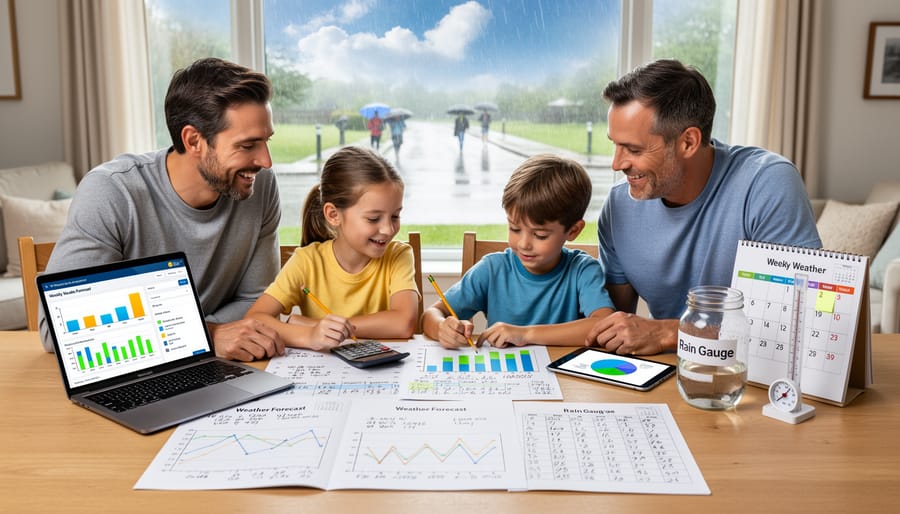
Every time you check whether tomorrow’s field trip will need raincoats or sunscreen, you’re relying on mathematical statistics at work. Weather forecasters don’t just guess, they use numerical weather prediction models that crunch massive datasets through probability calculations to predict temperature, precipitation, and wind patterns. These models analyze historical weather data, current atmospheric conditions, and thousands of variables to generate the forecasts you see on your phone.
The International Symposium on Forecasting, meeting June 28-July 1, 2026 in Montreal, brings together the world’s leading forecasting researchers to discuss exactly these kinds of statistical prediction challenges.
But here’s what makes this practical for your homeschool: you can actually see these predictions play out. Start tracking forecast accuracy with your kids. Check Monday’s prediction for Friday, then compare it to what actually happens. You’ll notice forecasts get more accurate as the target day approaches, that’s Bayesian updating in action, where statisticians continuously refine predictions as new data arrives.
This isn’t just about planning your nature walk. When your daughter tracks the forecasted high versus the actual temperature over two weeks, she’s learning about confidence intervals and margin of error. When your son notices the weather app says “30% chance of rain” but questions what that really means, you’re discussing probability interpretation together. These conversations build statistical literacy naturally, right alongside deciding whether to pack the umbrellas.
Health and Medical Decisions That Affect Your Family
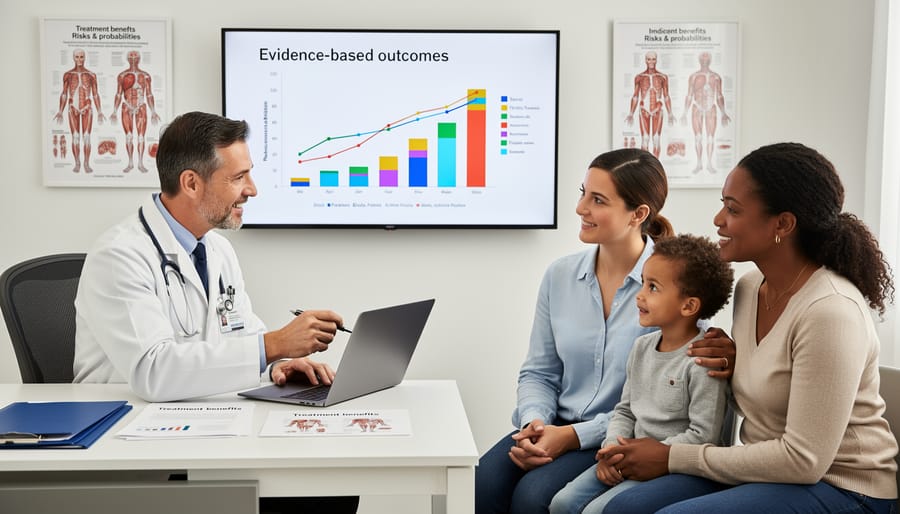
Every time you read about a new medication’s “95% effectiveness rate” or hear that a treatment “significantly reduces risk,” you’re encountering mathematical statistics in action. These numbers aren’t pulled from thin air, they come from carefully designed studies analyzing thousands of data points to determine what actually works.
When your pediatrician says a vaccine is safe and effective, that recommendation rests on statistical analysis of clinical trial data. Researchers use probability models to measure how often side effects occur, compare treatment groups against control groups, and calculate confidence intervals to show how reliable their findings are. Understanding even the basics of these concepts helps you evaluate health information critically rather than just accepting or rejecting it based on headlines.
This matters more than ever in 2026, when we’re constantly bombarded with conflicting health advice online. Can you spot the difference between a study of 50 people and one of 5,000? Do you know what “correlation doesn’t equal causation” actually means when someone claims a supplement cures everything? These statistical principles protect your family from misinformation.
You don’t need a statistics degree to teach your kids to ask better questions: How many people were studied? What were they compared against? Who funded the research? These critical thinking skills, rooted in statistical literacy, are genuine life skills that will serve them forever.
Sports Analytics Your Kids Already Love
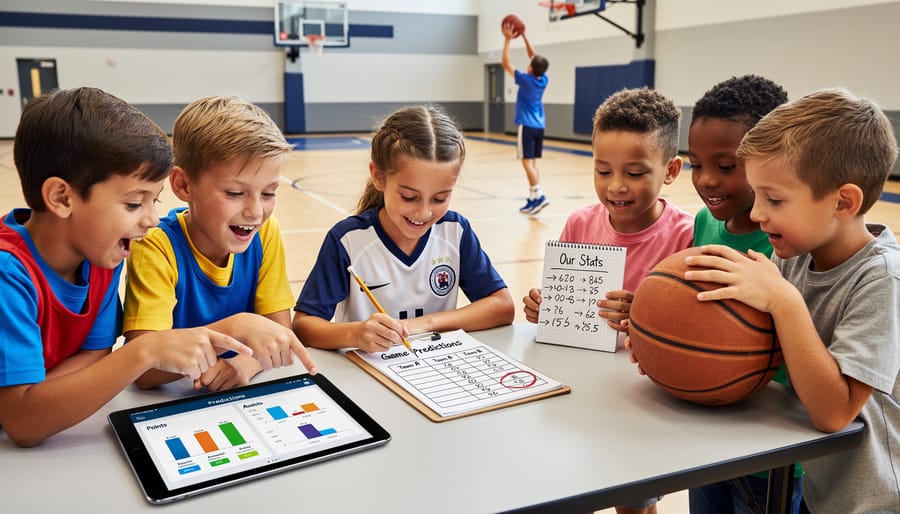
If your child can rattle off batting averages or debate whether a quarterback’s completion percentage actually matters, they’re already thinking statistically, they just don’t know it yet. Sports analytics transforms every game into a living math lesson, and kids eat it up because the stakes feel real to them.
Take basketball’s “player efficiency rating,” which combines points, rebounds, assists, steals, and blocks into a single number. That’s weighted statistics in action. Baseball’s “expected batting average” uses probability models to predict how often a batted ball should become a hit based on launch angle and exit velocity. When your soccer-loving teen argues that their favorite player creates more scoring chances than the stats show, they’re wrestling with the difference between correlation and causation, a fundamental statistical concept.
The beauty is that sports leagues publish mountains of free data, so your homeschooler can test real hypotheses: Do teams that shoot more three-pointers win more often? Does home-field advantage actually exist across different sports? These investigations teach data collection, analysis, and interpretation without a single worksheet. Your child learns to question whether hot streaks are statistically significant or just random variation, a skill that transfers directly to evaluating health claims, news reports, and financial projections later in life.
Financial Literacy and Future Planning
Money decisions are where statistics stops being theoretical and starts protecting your family’s future. When you’re choosing between investment options, statistics helps you understand risk versus return, not just the advertised ‘average’ returns, but the actual range of outcomes and the probability of losing money. Insurance premiums? They’re calculated using statistical models that predict likelihood of claims based on thousands of data points about people like you.
Your homeschooler learning to budget isn’t just tracking dollars in and out. They’re making predictions: How much will groceries cost next month? What’s the variance in our utility bills? Statistical thinking transforms guessing into informed estimation. When college planning rolls around, understanding how to evaluate scholarship probability, compare financial aid packages, or assess the ROI of different degree programs becomes crucial. Your teen who grasps percentiles, distributions, and probability doesn’t just see sticker prices, they see the full financial picture.
Even retirement planning relies on statistical projections about life expectancy, inflation rates, and market behavior. Teaching your children to question assumptions in financial models, understand what ‘guaranteed’ actually means, and recognize when someone’s cherry-picking favorable statistics gives them lifelong protection against manipulation. These aren’t abstract skills. They’re the difference between financial confidence and expensive mistakes.
Age-Appropriate Ways to Introduce Statistical Thinking at Home
Teaching statistical thinking doesn’t require a degree in mathematics or a complicated curriculum. The beauty of statistics is that it’s already woven into your daily life, which means you can introduce it naturally at any age.
Elementary Years: Building Intuition Through Play
Young children are natural data collectors. They count everything, cars, birds, toys, snacks. Start there. Have your six-year-old track the weather for a week using simple symbols (sun, cloud, rain) on a calendar. At the end, ask: “What happened most often?” That’s a frequency distribution, though you don’t need to call it that.
Create sorting games with household items. Buttons, rocks, or toy cars work perfectly. “How many ways can we group these? Which group has the most?” You’re teaching categorical data and comparison without worksheets. My daughter once spent an afternoon sorting her entire stuffed animal collection by size, color, and “softness level”, her own statistical variable at age seven.
Simple probability sneaks in through games. Roll dice and predict what might come up. Flip coins ten times and see if heads really shows up half the time (it usually doesn’t in small samples, which becomes a wonderful teaching moment). These activities build number sense and probabilistic thinking simultaneously.
Middle School: Connecting Stats to Their World
This is when you can introduce deliberate data collection projects. Have your middle schooler track their reading minutes, screen time, or basketball free-throw percentage for a month. Graph it together. Look for patterns. Calculate averages.
Sports statistics become powerful here. If your child follows baseball, basketball, or soccer, they’re already consuming statistics. Ask them to compare players using different measures. Why might batting average tell a different story than on-base percentage? They’re learning that how you measure matters.
Our family started a monthly “guess the grocery bill” challenge that turned into an ongoing probability exercise. Before checkout, everyone estimates the total. The closest guess wins choosing dessert that week. Over time, the estimates improved, we were learning from data.
Kitchen experiments work beautifully too. Baking different cookie recipes and rating them creates data about preferences. Plant seeds under different conditions and measure growth. These hands-on projects teach experimental design, data recording, and analysis without feeling like formal lessons.
High School: Real Statistical Tools
Teenagers can handle spreadsheet software and actual data analysis. Free tools like Google Sheets require zero technical expertise from parents. Your teen can download real datasets (weather data, sports statistics, economic indicators) and explore them independently.
Design surveys together about topics they care about, favorite streaming shows among friends, preferred study environments, music tastes. They’ll learn about sampling, question design, and data collection bias firsthand. When their results surprise them, they’re discovering what statisticians do professionally.
Consider connecting statistical work to your existing homeschool approach. If you’re using literacy-based planning have your teen analyze word frequency in their favorite novels. If you need general curriculum guidance, our starter guide offers frameworks that work across all subjects, including math.
The goal isn’t mastering advanced statistical theory. It’s developing a mindset that asks: What does the data actually show? How do I know? What am I missing? Those questions serve students far beyond any single math course.
Resources That Make Teaching Statistics Less Overwhelming
The good news? You don’t need a graduate degree in mathematics to guide your homeschooler through statistical thinking. The resources available today are designed with real learners in mind, not just academic specialists. I’ve watched parents who swore they were “terrible at math” successfully introduce their children to probability and data analysis using the right tools.
Start with what actually works in a home setting. *Mathematical Statistics With Applications* by Wackerly, Mendenhall, and Scheaffer remains a solid choice for high school students ready for structured learning, but it’s definitely not your only option. Many homeschool families prefer Khan Academy’s statistics courses because they’re completely free, self-paced, and include video explanations that both you and your child can watch together. The interactive exercises provide immediate feedback, which takes pressure off you as the teacher.
For hands-on learners, tools like StatKey and the free web-based platform Statcrunch let kids manipulate real data sets without installing complicated software. These platforms work beautifully whether you teach at the kitchen table or set up a room dedicated to your homeschool workspace. Your child can explore concepts by actually doing statistics rather than just reading about formulas.
| Resource | Best for Ages | Cost | Homeschool-Friendly Because |
|---|---|---|---|
| Khan Academy Statistics | 12-18 | Free | Self-paced videos, no prior knowledge needed, parent-friendly dashboard |
| StatKey (online) | 14-18 | Free | Visual simulations, no installation, works on any device |
| The Art of Statistics by David Spiegelhalter | 15+ | $18 | Real-world examples, conversational style, parent and teen can read together |
| Seeing Theory (seeingtheory.brown.edu) | 13-18 | Free | Beautiful visualizations, interactive, makes abstract concepts concrete |
Don’t overlook YouTube channels like StatQuest with Josh Starmer, which breaks down complex statistical concepts into short, entertaining videos with stick figure drawings and catchy songs. My own kids responded far better to his enthusiasm than they ever did to dense textbook explanations.
For younger students exploring foundational ideas, Bedtime Math offers free daily problems that sneak in probability and estimation skills without feeling like formal lessons. The physical manipulatives matter too: dice, playing cards, colored beads, and coins turn abstract probability into tangible experiments your child can repeat and verify.
The key is matching resources to your specific situation. If you prefer guided structure, Art of Problem Solving’s Introduction to Counting and Probability provides a complete curriculum with community forum support. If you thrive with flexibility, mixing free online tools with library books on data visualization gives you complete control over pacing and emphasis. You’re not looking for the single perfect resource; you’re building a toolkit that fits your family’s learning rhythm.
When Your Teen Shows Serious Interest: Next-Level Opportunities
Some homeschoolers discover a genuine passion for statistics that goes beyond casual interest. If your teen lights up when analyzing data or asks questions that stretch beyond introductory concepts, you’ll want to know what comes next.
Dual Enrollment and College Courses
Many community colleges and universities offer statistics courses that welcome motivated high schoolers. Start by reaching out to local institutions about their dual enrollment programs. Your teen could take an introductory statistics course for college credit, often at reduced tuition rates. Some colleges even waive prerequisites if you can demonstrate your student’s readiness through placement tests or portfolio review.
Online Learning Platforms
If local options feel limited, high-quality online courses provide flexibility. MIT OpenCourseWare offers free statistics courses with full lecture notes and problem sets. Coursera and edX feature university-level statistics programs where your teen can learn from professors at top institutions, many with certificates of completion that strengthen college applications.
Professional Communities and Conferences
Here’s something most parents don’t realize: the statistics community is remarkably welcoming to serious students. The Joint Statistical Meetings, the largest gathering of statisticians and data scientists in North America, isn’t just for professionals. Student attendance is encouraged, and many sessions are accessible to bright high schoolers who’ve covered the basics. Seeing real statisticians present cutting-edge research can be incredibly inspiring for a teen wondering whether this could be their future.
Competitions That Build Skills and Résumés
Look into the American Statistical Association’s competitions for high school students. These events challenge teens to tackle real datasets and present findings, building both technical skills and communication abilities. Science fairs with statistical analysis components also showcase this work well.
The key is matching opportunities to your teen’s genuine interest level rather than pushing. When the passion is real, these advanced options feel less like pressure and more like opening doors.
Common Parent Concerns (And Why They’re Totally Normal)
I’ll be honest: when I first considered teaching statistics to my kids, I had that familiar knot in my stomach. I barely scraped by in high school algebra, and here I was contemplating mathematical statistics? The fear was real, and if you’re feeling it too, you’re in excellent company.
The “I wasn’t good at math myself” concern is probably the most common worry I hear from homeschool parents. Here’s what changed everything for me: teaching statistics isn’t about reciting formulas or solving complex equations on command. It’s about helping your children recognize patterns, ask good questions about data, and think critically about numbers they encounter. You don’t need to be a math whiz to facilitate that kind of learning. In fact, learning alongside your kids often creates the most meaningful educational moments.
The belief that statistics seems too advanced is understandable, but it’s based on a misconception. Statistical thinking starts incredibly simply: comparing quantities, noticing what’s typical versus unusual, making predictions based on patterns. A seven-year-old tracking how many times it rains each month is doing statistics. A twelve-year-old calculating shooting percentages for their basketball team is applying statistical concepts. The advanced mathematics comes later, if at all, and by then your teen can access resources independently.
Many parents worry they’ll teach it wrong and somehow damage their child’s future understanding. This fear stems from the pressure we put on ourselves, often while managing homeschooling alongside everything else. The truth is that exploring statistics together, even imperfectly, builds far more genuine understanding than passively watching someone else get it “right.” Mistakes become learning opportunities. When you don’t know something, you model exactly what we want our children to do: look it up, ask questions, figure it out together.
What if I teach my child the wrong statistical concept?
Minor missteps in teaching statistics won’t derail your child’s mathematical future. Statistics is learned through exploration and application, so correcting misunderstandings as you discover them together is part of the natural learning process.
Do I need to finish a statistics course before teaching my kids?
Absolutely not. You can stay one step ahead in the material, learning concepts just before or alongside your children, which often makes you a more empathetic and effective teacher.
My teen understands statistics better than I do now, is that okay?
That’s actually wonderful and exactly what should happen. Your role shifts from instructor to facilitator, helping them find resources, asking thoughtful questions, and celebrating their growing expertise.
I still remember the day my daughter explained confidence intervals to me after working through a project on her own. My initial embarrassment quickly shifted to pride. She didn’t need me to know everything; she needed me to create the space and support for her to explore.
Your math anxiety doesn’t have to become their math anxiety. By approaching statistics with curiosity rather than fear, you’re teaching something more valuable than formulas: you’re teaching them that learning never stops and that it’s okay not to have all the answers from the start.
You don’t need to be a statistics expert to give your children a genuine advantage in the real world. That’s the beautiful truth about teaching mathematical statistics in your homeschool. Every time you discuss weather forecasts before planning your week, analyze sports statistics together, or help your teen understand a medical study, you’re building statistical literacy. These aren’t abstract exercises, they’re life skills that will serve your children whether they become data scientists or simply informed citizens making smart decisions.
Start where you are. Maybe that means counting M&Ms and graphing the colors with your seven-year-old, or it means letting your teenager explore a free online statistics tool for twenty minutes a week. Progress matters more than perfection. I’ve watched countless homeschool parents transform from “I’m terrible at math” to “I can’t believe we just figured that out together.” That shift happens when you stop trying to know everything in advance and instead learn alongside your kids.
The world your children are entering values people who can look at data, ask good questions, and spot patterns. You’re not just teaching math concepts, you’re teaching them to think critically, challenge assumptions, and make evidence-based decisions. That’s powerful.
So grab that weather app, pull up those baseball stats, or crack open a beginner-friendly statistics resource. Your homeschool just became a laboratory for real-world problem-solving. And honestly? Your kids are lucky to have you leading the way.