Preparing your teen for the AP Calculus AB exam means working through at least four to six full-length practice tests under timed conditions, ideally starting three months before test day. The exam itself consists of two main sections (multiple choice and free response), each divided into calculator and no-calculator portions, totaling three hours and fifteen minutes of testing. Most students aiming for a score of 3 or higher dedicate 20-30 hours specifically to practice exams beyond their regular coursework.
I get it. You’ve spent years creating a learning environment that feels nothing like traditional testing pressure, and now here we are, talking about bubble sheets and strictly timed sections. When my own daughter prepared for her AP exam, I struggled with this tension too. How do we honor the flexible, relationship-rich approach that makes homeschooling beautiful while also preparing our kids for a very rigid, very traditional assessment?
The truth is, practice exams serve a purpose beyond just content review. They build stamina for a marathon test session that requires switching between different types of thinking (conceptual understanding, procedural fluency, problem-solving creativity) under pressure. Your teen might ace every problem in their textbook given enough time, but the AP exam demands something different: accuracy and depth within tight time constraints.
The good news? You don’t need to transform your entire homeschool into test-prep boot camp. Strategic practice that mirrors actual exam conditions, combined with thoughtful review of mistakes, prepares students far more effectively than endless drilling. Your role shifts from teacher to coach, helping your teen develop test-taking strategies, manage anxiety, and identify which topics need focused attention in the weeks ahead.
Understanding What Your Student Is Actually Facing
Let’s talk about what your student will actually encounter on May 11, 2026, not in intimidating test-prep language, but in terms that make sense for parents helping their homeschoolers navigate this.
The AP Calculus AB exam uses a hybrid digital Bluebook format which sounds more complicated than it is. Here’s what that means in practice: your student will sit at a computer to read multiple-choice questions and see the free-response prompts. They’ll click their answers for the multiple-choice section directly in the Bluebook app. But when they get to the free-response questions, they’ll handwrite their answers in traditional paper booklets, just like students have done for decades. Think of it as technology meeting classic test-taking.
The exam runs for three and a half hours total, split into two main sections. Each section carries equal weight, 50% of the final score. What catches many homeschool parents off guard is the calculator policy, which changes partway through. For the first chunk of multiple-choice questions, calculators aren’t allowed at all. Then they become required. It’s specific, and your student needs to know it going in.
Here’s the breakdown that matters:
| Section | Questions | Time | Calculator | % of Score |
|---|---|---|---|---|
| Section I, Part A | 30 multiple-choice | 60 minutes | Not permitted | 50% total |
| Section I, Part B | 15 multiple-choice | 45 minutes | Required | (Section I combined) |
| Section II | 6 free-response | 90 minutes | Mixed (2 with, 4 without) | 50% |
The timing matters more than you might expect. Your student can’t bank extra minutes from one part to use on another. When those 60 minutes are up for Part A, they’re done, even if they’d love five more minutes to check their work. For homeschoolers used to flexible pacing and taking breaks when needed, this rigid structure can feel jarring.
The good news? The format stays consistent year to year. Once your student practices with this structure a few times, it becomes familiar territory rather than an intimidating unknown. That’s exactly why practice exams exist, not to judge your homeschooler, but to make exam day feel like something they’ve done before.

Why Practice Exams Matter More in a Homeschool Setting
Your homeschooler might breeze through calculus problems at the kitchen table, working at their own pace with music playing softly in the background. They can pause to grab a snack, look up a formula, or spend an extra twenty minutes on a challenging concept. That’s the beauty of homeschooling, and it’s how deep learning happens.
But here’s what keeps many homeschool parents up at night: the AP Calculus AB exam won’t look anything like that.
Your student will face 45 multiple-choice questions in 105 minutes on a computer screen they can’t close. They’ll handwrite responses to free-response questions in a paper booklet while everyone around them flips pages. There’s a proctor, strict timing, a specific graphing calculator they must bring, and zero flexibility to take a break when anxiety hits.
Practice exams bridge this gap between the freedom of homeschool learning and the rigid reality of standardized testing. They expose your student to time pressure they rarely experience at home. Most homeschoolers don’t race against a clock to finish math problems, but on May 11, 2026, the timer won’t pause for anyone.
These practice sessions also reveal gaps that might stay hidden in daily work. When your student can flip back through their textbook or ask you a quick question, weaknesses get masked. A timed practice exam with no safety nets shows exactly where understanding breaks down under pressure.
This doesn’t mean your homeschool approach is lacking. You’ve likely built mathematical understanding that runs deeper than many traditionally schooled students have. But testing stamina is a separate skill, and one that requires its own preparation. Think of practice exams as teaching your student a second language, the language of standardized testing, without abandoning the rich, exploratory math education you’ve already provided.
The good news? Homeschoolers often adapt quickly once they understand the format. They’re used to taking ownership of their learning, which makes strategic test prep feel like just another project to master.
Creating Your Practice Exam Schedule (That Actually Works)
Starting Point: Where Is Your Student Right Now?
Before you map out a practice schedule, take a honest look at where your student is right now. This isn’t about judgment, it’s about planning that fits learning instead of forcing a one-size-fits-all approach.
Sit down with your student and work through a few calculus problems together from different topics: derivatives, integrals, limits. Watch how they think through the work. Are they confident with the mechanics but shaky on word problems? Do they understand concepts but make careless errors under time pressure? Maybe they’re solid on everything except that one unit that never quite clicked.
If your student hasn’t seen all the material yet, that’s completely fine, you’ll build practice exams in gradually as they learn. If they’re finishing content now, try one untimed practice section to see what they actually know versus what needs review. Their score matters less than identifying patterns: which question types trip them up, where they lose time, what they skip entirely.
Use what you discover to decide how often they need practice. A student who’s mastered most content might need just monthly practice until March. Someone still building confidence might benefit from shorter, focused practice sessions every other week starting earlier.
The Practice Timeline That Takes the Pressure Off
Working backward from the regularly scheduled May 11, 2026 exam date gives you a surprisingly manageable timeline if you start now.
If your student is currently working through calculus content (not yet finished), aim to complete the curriculum by late February 2026. This leaves March and April for focused review and practice. Start with one full practice exam in early March to establish a baseline. It doesn’t need to be perfect, you’re gathering information about which topics need attention.
Through March and early April, shift your homeschool planning to include one practice exam every two weeks. Between exams, target the specific concepts where your student struggled. This rhythm prevents burnout while building familiarity with the format and timing. Your student gets comfortable with the hybrid digital interface and the pressure of writing responses within strict time limits.
In the final three weeks before May 11, increase to one practice exam per week. By late April, your student should feel like the exam format is just another day’s work, familiar, manageable, not intimidating. Schedule the last practice exam about five days before the actual test, then step back. Those final days are for rest, light review of formulas, and maintaining confidence.
If you’re starting in January or February, this timeline compresses but remains doable. The key is consistency, not cramming.
Where to Find Quality AP Calculus AB Practice Exams
Finding solid practice materials shouldn’t require a PhD in internet research. You need resources that actually mirror what your student will face on May 11, 2026, without wading through outdated materials or gimmicky prep courses that promise miracles.
Start with the College Board itself. They provide official practice exams that use the same format your student will encounter, the hybrid digital setup with the Bluebook app for multiple-choice and free-response questions, paired with handwritten responses in paper booklets. These official materials are your gold standard because they’re written by the same people who create the actual exam. The College Board’s AP Classroom also offers question banks and practice sets, though access typically comes through your student’s AP course registration.
For print resources, look for AP Calculus AB prep books from established publishers like Barron’s, Princeton Review, or Peterson’s. Check publication dates carefully, you want materials from 2024 or later that reflect the current hybrid format. Older books won’t prepare your student for the digital interface they’ll actually use.
Free online options exist, but quality varies wildly. Khan Academy partners with the College Board and offers legitimate practice problems organized by topic. Some college math departments post practice exams, though these may not match the current format exactly. Be cautious with random websites promising “free AP exams”, they’re often outdated or poorly designed.
When evaluating any practice material, look for these markers of quality:
- Matches the current hybrid digital format and timing structure
- Clearly separates calculator and no-calculator sections
- Provides detailed answer explanations, not just correct answers
- Reflects realistic difficulty and question styles
- Includes both multiple-choice and free-response practice
- Updated within the past two years
Your goal isn’t to collect every practice exam available. Three to five full-length practice exams from reliable sources, used strategically over several months, will serve your student far better than twenty mediocre ones. Quality trumps quantity every time, especially when you’re working within your homeschool rhythm rather than a classroom’s mandated schedule.
Making Practice Exams Actually Useful (Not Just Stressful)
Setting Up Test Conditions at Home
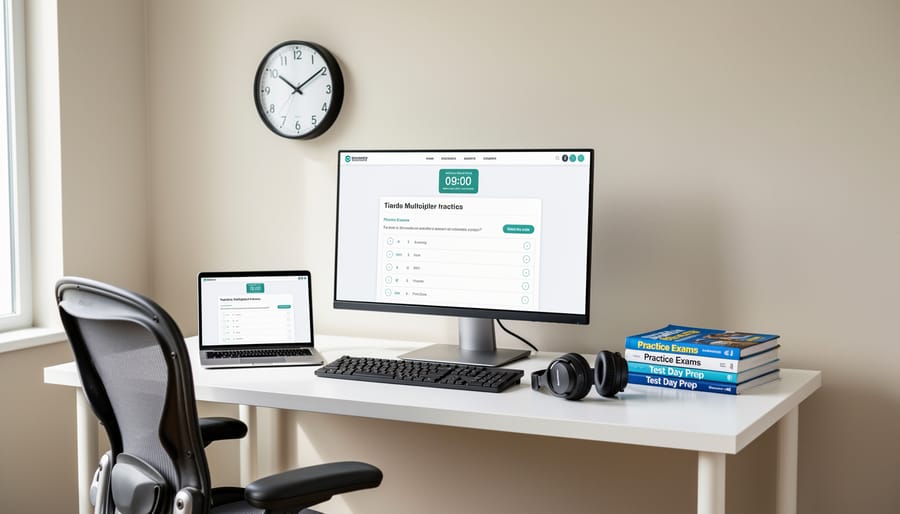
Creating test conditions at home doesn’t require perfection, just consistency. Start with your homeschool room setup and designate a quiet spot where your student won’t be interrupted for the full exam duration. Section I runs 1 hour 45 minutes total, so block that time completely.
Here’s what matters most: your student needs both the Bluebook app on their device for viewing questions and blank paper for the free-response section. They’ll handwrite answers just like on test day. For Section I Part A (60 minutes, 30 questions), calculators are forbidden, hide them if needed. Then immediately switch to Section I Part B (45 minutes, 15 questions), where a graphing calculator is required and must be accessible.
Set a visible timer. Don’t let them pause between parts, the real exam doesn’t stop.
Keep the room temperature comfortable but not cozy. A little bit of environmental challenge actually helps simulate test-day conditions. Your goal isn’t to stress them out but to remove surprises before May 11, 2026.
The Post-Exam Review That Makes All the Difference
The real learning happens after your student puts down their pencil. This is where you shift from being the test proctor to being your student’s most valuable learning partner.
Start by sitting down together while the exam is still fresh in their mind. Don’t lead with “How many did you get wrong?”, that immediately creates defensiveness. Instead, ask “Which problems made you think hardest?” or “Where did you feel confident, and where did you hesitate?” This opens the conversation to actual learning rather than just scoring.
Work through the exam together, problem by problem, but not all in one sitting. Tackle the multiple-choice questions your student missed first, having them explain their reasoning out loud. Often they’ll catch their own mistake in the explanation, which cements the learning far better than you pointing it out. When they’re truly stuck, guide them with questions rather than answers: “What concept is this testing?” or “What would happen if you tried a different approach?”
For the free-response questions, focus on the scoring rubric. Help your student see that partial credit matters, they don’t need perfection. If they set up a problem correctly but made an arithmetic error, that’s different from not understanding the concept at all. This distinction helps them see progress and understand what actually needs more work.
Create a simple error log together. Not an intimidating spreadsheet, just a notebook page where you jot down patterns: “Forgot to check domain restrictions” or “Integration by parts, need more practice.” This running list becomes your study roadmap, far more useful than any generic review schedule.
Most importantly, celebrate what they got right. Homeschooling means you’ve watched them grow from basic algebra to calculus, that’s remarkable. Acknowledge their effort before drilling into mistakes.

Addressing Calculator Requirements Without the Confusion
The calculator requirement trips up more homeschool parents than almost any other aspect of the AP Calculus AB exam, but it’s actually straightforward once you understand the two-part structure.
Section I Part A (the first 30 multiple-choice questions) is calculator-free. Your student won’t have access to any calculator for a full hour. This tests whether they truly understand calculus concepts and can work through problems by hand. Section I Part B (the final 15 multiple-choice questions) requires a graphing calculator, not just permits it, but requires it. The questions in Part B are specifically designed around calculator capabilities.
The free-response section follows the same pattern: some questions don’t allow calculators, while others require them. College Board maintains a list of approved graphing calculators on their AP Central site, so follow calculator instructions carefully when selecting your device.
Most homeschoolers use a TI-84 Plus or similar model, which covers all the necessary functions. What matters more than the specific model is that your student becomes completely comfortable with whatever calculator they’ll use on exam day. They should know how to graph functions, find intersections, calculate derivatives and integrals, and work efficiently without hunting for buttons.
During practice exams at home, enforce the same calculator rules as the actual test. When working through Part A questions, put the calculator away entirely. For Part B, make sure it’s readily available. This discipline helps your student develop the mental switching required on exam day and takes away one more variable that could reduce homeschool stress as May 11, 2026 approaches.
When Your Student Struggles: What Homeschool Parents Need to Know
Let’s be honest about something most test prep resources won’t tell you: sometimes practice exam scores are genuinely discouraging. If your student has been working hard and the numbers still aren’t where you hoped, you’re probably wondering if you’ve failed them somehow. You haven’t. This is actually one of those moments where homeschooling gives you options that traditional school families don’t have.
First, take a breath and look at the whole picture. Are we talking about one bad practice exam after weeks of steady improvement, or consistently low scores across multiple attempts? Is your student struggling with the content itself, or with the timing and format? A student who understands calculus but panics under timed conditions faces a very different challenge than one who hasn’t mastered the underlying concepts. The solution depends entirely on what’s actually happening.
If the issue is content mastery, you have time before May 11, 2026 to make real changes. Consider slowing down, revisiting fundamentals, or finding a different teaching approach that clicks better with your student’s learning style. Sometimes bringing in an outside tutor or online course provides the fresh perspective that makes everything fall into place. There’s no shame in seeking help, it’s smart homeschooling.
But here’s the harder question: should your student even take this exam? I know that feels like giving up, but sometimes the most loving thing we can do is release our kids from expectations that aren’t serving them. If practice exams are creating genuine misery, destroying your relationship, or convincing your student they’re not good at math when they actually are, you get to make a different choice. The AP exam is optional. College admission is still possible without it. Your child’s mental health and love of learning matter more than any test score.
On the other hand, some students need to push through difficulty to discover what they’re capable of. You know your child. You’ve watched them face challenges before. Trust that knowledge. If this feels like a mountain they need to climb, support them through it. If it feels like unnecessary suffering, give yourself permission to step back. The beauty of homeschooling is that you get to decide what’s right for your family, not what everyone else thinks you should do.
Here’s the thing I want you to remember as you look at that May 11, 2026 exam date on your calendar: your child’s worth isn’t measured by a three-hour test. I’ve watched my own kids walk through standardized assessments, and yes, we prepared them practically. But I never let those scores define what I already knew, that our homeschool journey had given them something far more valuable than test performance. It gave them a genuine love of learning.
You’ve already done the hard work. You’ve taught your student to think deeply, to persist through challenges, to see mathematics as more than bubbles on a scan sheet. The practice exams you’re working through together? They’re just one tool in your toolkit, not a verdict on your homeschooling.
Can you guide your student through AP Calculus AB prep? Absolutely. You don’t need a teaching certificate to sit beside them, help them review mistakes, and remind them they’re capable. You’ve been doing harder things than this since the day you chose homeschooling.
So prepare practically, but don’t lose sight of what matters. Whether your student earns that college credit or not, they’re learning resilience, discipline, and how to tackle something difficult with your support. That’s the real education happening here. Trust yourself. Trust your student. And trust that the homeschool path you’ve chosen is exactly where you’re meant to be.