
A basis in linear algebra is a minimal set of vectors that can be combined to create every possible vector in a given vector space. Think of it as the essential building blocks you need, and only those you need, to construct anything within a particular mathematical framework.
If you’re homeschooling a high schooler who’s tackling college-level math or preparing for STEM fields, understanding basis is one of those watershed moments. It’s where linear algebra shifts from abstract formulas to a tool that explains how computer graphics render images, how engineers compress data, and how physicists describe quantum states. Your student isn’t just learning theory; they’re gaining the conceptual foundation that powers technology they use daily.
Here’s the beautiful part: the idea behind basis isn’t as intimidating as the textbooks make it sound. At its core, a basis gives you two guarantees. First, you can reach any point in your space using just these vectors. Second, none of these vectors are redundant. Remove even one, and you lose coverage. Add an extra, and you’ve included something unnecessary.
I remember when my oldest first encountered basis vectors in her precalculus course. She was frustrated because the definition felt circular. But once we connected it to something tangible (how you only need north-south and east-west directions to describe any location on a flat map), the concept clicked. That’s the approach this article takes: plain language, real examples, and practical strategies for homeschool parents guiding their students through this pivotal concept. You don’t need an advanced math degree to help your teen grasp why basis matters or how to work with it confidently.
What a Basis Actually Means (In Plain English)

Think of a basis like the primary colors in a paint set. Just as red, yellow, and blue can mix to create every other color, a basis is the smallest set of building blocks you need to create everything in a mathematical space. When your teen starts linear algebra, they’ll learn that a basis gives you the minimum ingredients required, no extras, no redundancies, to construct any vector they might need.
Here’s the part that helps it click: a basis isn’t just a random collection of vectors. It’s specifically chosen so that each piece adds something unique (nothing is redundant), and together they can reach anywhere in the space (nothing is missing). Imagine trying to navigate a city. You need directions like “north-south” and “east-west.” These two directions form a basis for moving anywhere on a flat map. You don’t need a third direction because any location can be described using just those two. Add a third, and you’d have redundancy. Remove one, and you couldn’t reach everywhere.
Before we go further, let’s clarify a few terms your student will encounter:
- Vector
- A mathematical object with both magnitude and direction, often represented as an arrow or a list of numbers.
- Vector space
- The entire collection of all possible vectors that follow certain mathematical rules, like a playground where vectors live and interact.
- Linear combination
- Creating new vectors by multiplying basis vectors by numbers (called scalars) and adding them together, like mixing ingredients in different proportions.
- Coordinate
- The specific numbers that tell you how much of each basis vector to use to reach a particular point, just like an address tells you how far north and east to go.
Understanding basis as coordinate system helps demystify what might otherwise seem abstract. When your student picks a basis, they’re essentially choosing their reference frame, their way of describing where everything sits. Different bases can describe the same space, just as you might give directions using street names or compass directions, but both get you to the same destination.
How a Basis Works in Linear Algebra
Linear Independence: No Redundancy Allowed
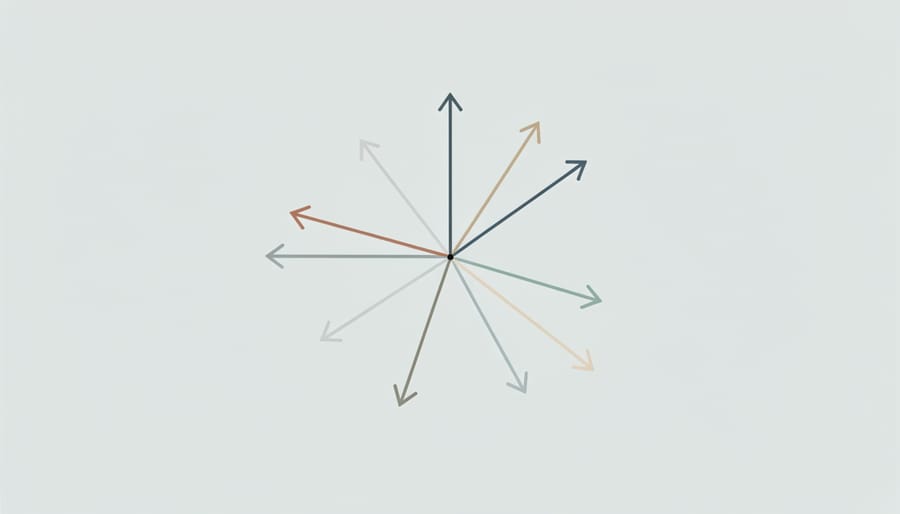
Think of linear independence like giving directions to someone. If you say “go north,” that’s one direction. If you say “go east,” that’s another. Notice that no amount of walking north will ever get you to the same place as walking east, neither direction can substitute for the other. That’s linear independence in a nutshell: each vector in your basis brings something genuinely new to the table that you can’t get by mixing the others.
In math terms, a set of vectors is linearly independent when you can’t write any vector in the group as a combination of the others. It means there’s no redundancy, no overlap in what each vector contributes. If you could make one vector by adding or scaling the others, you’d have a dependency, and that vector would be deadweight in your basis.
Here’s why this matters for your student: imagine trying to describe every location in a room using only directions that all point northeast. You’d be stuck on a diagonal line, unable to reach points to the left or right of it. That’s what happens without linear independence, you lose the ability to reach parts of your space. Each basis vector must pull its own weight by pointing in a direction the others can’t cover.
When your teen works with basis vectors, they’ll check for linear independence to confirm none of the vectors are just disguised copies of combinations they already have.
Span: Reaching Every Point in the Space
Think of span as your basis vectors’ reach. If your vectors form a proper basis, their span must cover every single point in the space you’re working with, no gaps allowed.
Here’s what that means in practice: you can take your basis vectors, multiply each one by some number (called a scalar), add all those results together, and land on any vector in your space. It’s like having a universal recipe where the right combination of your basic ingredients creates any dish you need.
A simple example helps. In two-dimensional space (think a flat piece of graph paper), two basis vectors might point northeast and northwest. By scaling and combining them, say, three units of the first vector plus two units of the second, you can reach any point on that plane. Too few basis vectors and you’ll have blind spots; the right number lets you reach everywhere.
This “reaching everywhere” property is what makes span one of the core concepts in linear algebra, right alongside linear independence, basis, and dimension. They all work together: independence ensures no redundancy, span ensures complete coverage, and together they define what makes a proper basis. Your student will see these concepts appear again when they study coordinate systems, change of basis transformations, and more advanced topics like eigenvalues.
For homeschooling parents, the key takeaway is this: a basis isn’t just independent, it must also be comprehensive enough to describe the entire space.
Different Types of Bases Your Student Might Encounter
As your teen works through linear algebra, they’ll encounter a few different types of bases, each with its own special properties. Don’t let the names intimidate you, once you understand the basic idea, the differences are pretty straightforward.
The most common starting point is the standard basis. In two-dimensional space, that’s just the vectors pointing along the x-axis and y-axis (mathematically written as (1,0) and (0,1)). In three dimensions, you add a third vector pointing along the z-axis. Think of these as the default coordinate system we all learned in geometry class. The standard basis is simple and intuitive, which is why it shows up constantly in textbooks and homework problems.
Beyond the standard basis, students will meet variations designed for specific purposes:
- Orthogonal basis: vectors that meet at right angles to each other, like the corners of a rectangular room
- Orthonormal basis: orthogonal vectors that have been scaled to length 1, making calculations cleaner
- Ordered basis: any basis where the sequence of vectors matters for certain operations
Why does your student need to know about different types? Because choosing the right basis can make a problem dramatically easier to solve. Some calculations that look messy in the standard basis become simple when you switch to an orthonormal basis. It’s like choosing whether to measure a room in inches or feet, the room doesn’t change, but one choice might make your math easier.
This connects directly to the change of basis concepts your student will study as they progress. They’ll learn techniques for translating between different coordinate systems, which is essential for advanced applications. The ability to work flexibly with different bases shows up throughout intro linear algebra topics like eigenvalues, matrix decomposition, and beyond.
The good news? Your homeschooler doesn’t need to master every type of basis immediately. Most courses introduce these gradually, starting with the standard basis and building toward the specialized varieties as applications demand them. Understanding that different bases exist and serve different purposes is half the battle.
Where Basis Concepts Show Up (and Why They Matter)
Your student might grasp the concept of basis in their textbook, but here’s where they’ll actually use it: everywhere in STEM fields. Understanding basis isn’t just an abstract exercise, it’s the foundation for how computers render 3D worlds, how data scientists reduce massive datasets to their essential patterns, and how engineers model everything from aircraft wings to electrical circuits.
In computer graphics, every image on screen relies on coordinate systems built from basis vectors. When a game character rotates or a camera angle shifts, programmers use change of basis transformations to translate positions from one coordinate system to another. The smooth 3D worlds your teen navigates in games? Those exist because developers understand how to work with different bases.
Data science applications get even more practical. When companies analyze customer data or scientists process medical imaging, they often face datasets with hundreds of dimensions. Techniques like principal component analysis use basis concepts to find the most important directions in that data, essentially choosing a new basis that reveals the underlying patterns. Your student’s college-level linear algebra course will likely cover these eigenvalues and eigenvectors that make this dimension reduction possible.
Physics simulations depend heavily on choosing the right basis. Whether modeling vibrations in a bridge, quantum states in a molecule, or electromagnetic waves, physicists select bases that make complex problems manageable. An orthonormal basis, for instance, simplifies calculations dramatically because its vectors are both perpendicular and unit length.
The takeaway for homeschooling parents? When your teen asks why they need to understand basis, you can point to these real applications. Every STEM major, from computer science to mechanical engineering to physics, will encounter these concepts repeatedly. College courses like linear algebra build directly on this foundation, using basis to explore coordinate vectors, change of basis, and higher-level transformations. Understanding it now means your student enters college-level math with confidence rather than confusion.
Supporting Your Homeschooler Through Linear Algebra

You don’t need to be a linear algebra expert to help your teen through this challenging subject. When my oldest started exploring college-level math concepts at home, I’ll admit I felt out of my depth. But I learned that supporting advanced math isn’t about knowing all the answers, it’s about helping them find the right resources and building problem-solving confidence.
Start by acknowledging that linear algebra sits beyond typical high school curriculum. Most students encounter it in their first or second year of college, so if your homeschooler is ready for it in high school, they’re working ahead. That’s worth celebrating, but it also means you’ll likely need external support. The 3Blue1Brown linear algebra video series offers exceptional visual explanations that make abstract concepts like basis and span tangible. I’ve watched these myself just to understand what my kids were learning.
Consider a structured textbook alongside video resources. Look for ones with worked examples and full solution keys, since you’ll want your student to check their own work. When concepts like change of basis or eigenvalues prove particularly sticky, that’s when I’d bring in outside help. A weekly tutoring session or a co-op class with other advanced students can provide the direct instruction that’s hard to replicate at home.
How do you assess understanding when you can’t solve the problems yourself? Ask your student to explain concepts back to you in plain language. If they can describe what makes a set of vectors a basis without hiding behind jargon, they probably grasp it. Watch for whether they can apply ideas to new problems, not just repeat memorized procedures.
Linear algebra is demanding, but it fits beautifully into homeschooling’s flexibility. You can adjust pacing, pause for deeper exploration, and manage homeschooling around your student’s readiness rather than arbitrary grade levels.
Common Questions About Basis and Linear Algebra
What math should my student complete before tackling linear algebra?
Most students need a solid foundation in algebra 2 and trigonometry before starting linear algebra. Some familiarity with functions and basic proof concepts helps, though many college courses teach linear algebra concurrently with calculus rather than requiring calculus as a prerequisite.
How is linear algebra different from the algebra my teen already studied?
While algebra 1 and 2 focus on solving equations with single variables, linear algebra works with systems of equations, vectors, and transformations in multi-dimensional spaces. It’s less about finding x and more about understanding relationships between entire sets of numbers.
Do all STEM majors really need linear algebra?
Nearly all STEM fields use it. Engineering, computer science, physics, and data science programs typically require linear algebra because concepts like vector spaces, eigenvalues, and matrix decomposition underpin everything from computer graphics to machine learning algorithms.
Can I teach this at home, or should I look for outside help?
Many homeschooling families successfully use online courses, community college dual enrollment, or co-op classes for linear algebra. You don’t need to teach it yourself, your role is helping your student find quality instruction and staying involved enough to monitor their progress and understanding.
The beauty of homeschooling advanced math is that you can customize the approach to your student’s learning style and schedule. Some families introduce linear algebra concepts earlier than traditional schools would, especially if their teen shows strong aptitude in math and plans to pursue engineering or computer science. Others wait until college, recognizing that dual enrollment or freshman-year courses work perfectly fine.
Don’t let the unfamiliar terminology intimidate you. When your student talks about vector spaces or linear maps, ask them to explain it in their own words. That helps them solidify their understanding and gives you insight into whether they’re truly grasping the material or just memorizing procedures. The goal isn’t for you to become a linear algebra expert, it’s to create an environment where your student can explore challenging material with support and encouragement.
Understanding what a basis is might seem like a small step, but it gives you the confidence to guide your teen through one of the most powerful areas of mathematics. You don’t need to solve every problem yourself, you just need to grasp the core idea well enough to ask good questions, find the right resources, and recognize when your student truly understands the concept.
That’s the beauty of homeschooling. You can introduce linear algebra when your child is genuinely ready, not because a curriculum calendar says it’s time. If they’re breezing through advanced algebra and showing interest in STEM fields, you have the freedom to explore topics like basis and vector spaces at their pace. And if they need extra time to build foundational skills first, that’s perfectly fine too.
I’d love to hear how you’re navigating higher math at home. What resources have worked for your family? What challenges have you faced? Browse more math and science support articles here at Sunny Patch, and don’t hesitate to share your own experiences in the comments. We’re all learning together, and that includes topics far beyond the calculus bridge your dentist might mention at your teen’s next checkup.